
Large Loss and Catastrophic Response in Gulfport
24/7 large loss and catastrophic response in Gulfport and surrounding areas. IICRC-certified, insurance billing accepted. Call +12282845200.
Large loss event at a commercial property or multi-unit building in Gulfport? When a fire, flood, or storm surge affects an entire structure or multiple buildings at once, the response has to scale immediately, not grow one phone call at a time. We answer 24/7 and mobilize crews, equipment, and large loss adjusters’ documentation from the first hour on site.
A large loss isn’t a bigger version of a residential water call. It’s a different operational category: multiple affected floors or units, structural systems (HVAC, electrical, elevators) that have to be assessed before drying even starts, and often a general contractor, property manager, and multiple insurance stakeholders all needing the same information at the same time. Catastrophic loss response covers hurricane storm surge, major fire loss in commercial or multifamily buildings, large-scale pipe failures in high-rise or garden-style apartment complexes, and any event where the damage footprint exceeds what a standard 2 to 4 person crew can safely contain.
What large loss and catastrophic response actually involves
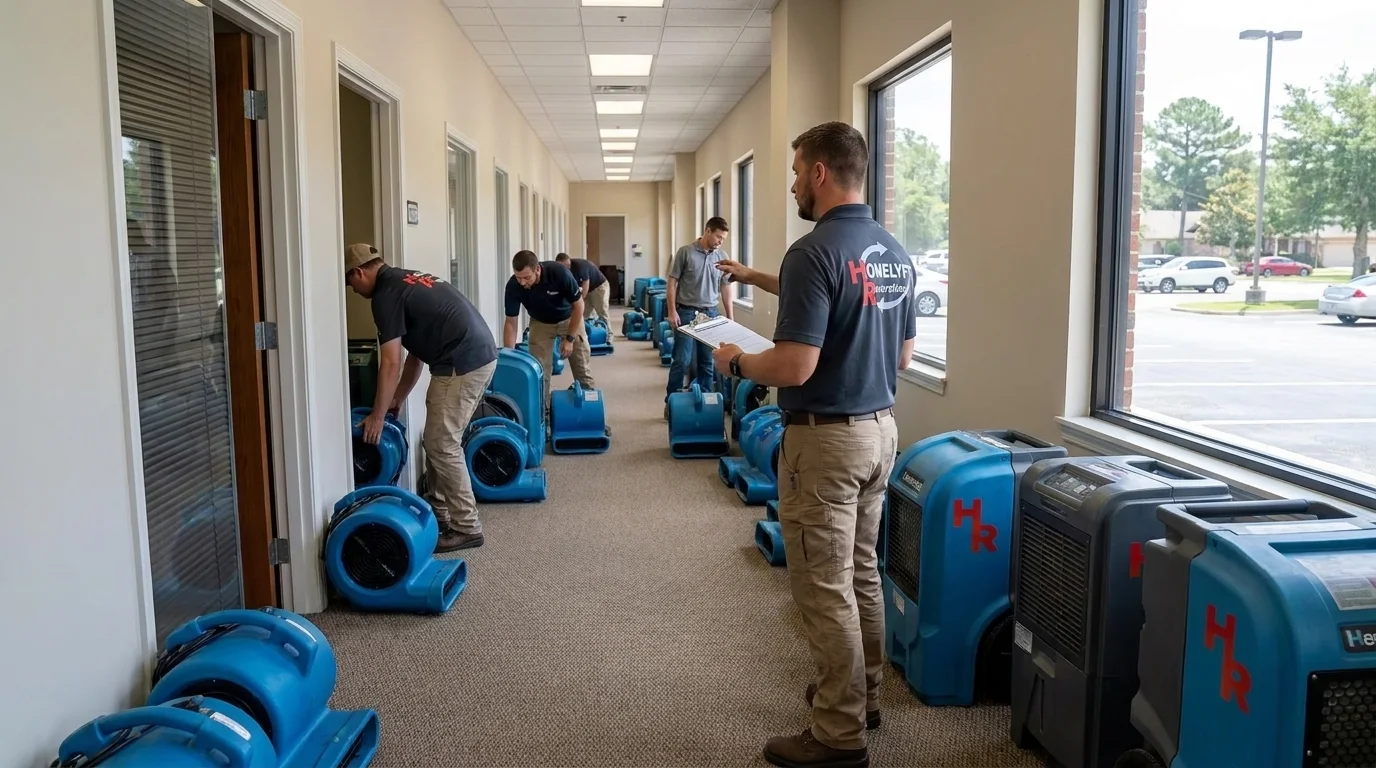
Large loss work means running parallel drying zones instead of one, often with dozens of air movers and multiple commercial dehumidifiers tracked against a single moisture map so nothing gets missed between units. It means coordinating with building engineers on power and water shutoffs, staging contents pack-out for entire floors, and keeping a documentation trail detailed enough to support a claim that may run into six or seven figures. On the Mississippi Gulf Coast, that often means commercial slab-on-grade construction, garden apartments with shared attic space that lets water or smoke travel between units, and buildings close enough to the water that storm surge and wind damage hit the same structure simultaneously.
Our process
- Initial scoping and stakeholder call. Before equipment moves, we get the property manager, ownership group, and any assigned large loss adjuster on the same page about scope, access, and safety hazards like compromised electrical or structural elements.
- Zone mapping and crew mobilization. The affected area is divided into drying or remediation zones so multiple crews can work simultaneously without duplicating effort or missing a section.
- Structural and moisture assessment across the full footprint. Moisture mapping, thermal imaging, and air quality checks run building-wide, not room by room, so the scope of work reflects the actual loss.
- Mitigation and drying at scale. Extraction, containment, and structural drying run per IICRC S500 standards, with daily moisture logs across every affected unit or floor, not just a sample.
- Documentation and handoff to reconstruction. Photo and moisture-log documentation is compiled for the adjuster and ownership before any rebuild work begins, so the paper trail matches what actually happened on site.
What separates a good large loss response from a bad one
The most common failure in catastrophic response is undersizing the initial crew and equipment, which lets drying fall behind the clock and lets secondary damage (mold, delamination, corrosion) start in units that were only marginally wet. Large loss adjusters are looking for consistent daily documentation across the whole site, not a single inspection report. They also watch for scope creep that isn’t backed by moisture readings or photos, since that’s what slows claim approval. A properly run large loss job keeps a single point of contact coordinating between crews, the adjuster, and the property manager so decisions don’t get made in three different places at once, and keeps detailed logs on every affected unit so partial-loss and total-loss determinations hold up under review.
What does large loss and catastrophic response cost?
Costs on catastrophic and large loss jobs vary enormously based on square footage, number of units affected, and whether the loss involves fire, water, wind, or a combination. The ranges below are typical industry figures for the categories involved, not a quote. Every large loss is scoped individually, and HomeLyft Restoration MS provides a written scope of work before mobilization begins so ownership and adjusters know what’s included.
| Scenario | Typical range |
|---|---|
| Multi-unit water loss, 10-20 units | $50,000 - $250,000 |
| Commercial fire loss, single building | $100,000 - $750,000 |
| Storm surge damage, ground-floor commercial | $150,000 - $1,000,000+ |
| Multi-building apartment complex, mixed water/wind | $500,000 - $3,000,000+ |
| Contents pack-out, large commercial space | $20,000 - $150,000 |
Commercial property insurance typically covers large loss restoration when the cause is a covered peril under the policy, though business interruption, code upgrade coverage, and deductible structure vary widely by carrier and policy type, so confirming coverage specifics with the adjuster early is part of the process.
Seasonal & regional considerations
Hurricane season brings the Gulf Coast’s highest concentration of catastrophic claims, with storm surge, wind-driven rain, and roof failures often hitting the same building at once. Gulfport’s proximity to the water and the coast’s older multifamily and commercial stock, much of it built before current FORTIFIED and windstorm codes, means a single storm event can generate multiple large loss claims in the same complex or business park. Humidity levels along the coast also mean mold growth can start within 24 to 48 hours in large wet structures that aren’t dried fast enough, which is part of why crew scale matters more here than in drier climates.
Service area
HomeLyft Restoration MS responds to large loss and catastrophic events across Gulfport and the surrounding Mississippi Gulf Coast, including commercial corridors, multifamily complexes, and coastal properties throughout the region.
If you’re managing a property with damage across multiple units or floors, don’t wait for the full picture before calling. Contact HomeLyft Restoration MS at (228) 284-5200 to begin large loss mobilization and get a written scope of work started.
Frequently Asked Questions
Does homeowners or commercial property insurance cover large loss and catastrophic restoration?
What actually qualifies a loss as "large loss" rather than standard residential damage?
How is mobilization different for a catastrophic event versus a single-unit water loss?
How do large loss adjusters typically want documentation handled on multi-unit jobs?
What happens to tenants or occupants during a large loss or catastrophic response?
Looking for the best large-loss-response company in Gulfport?
HomeLyft Restoration MS provides licensed and insured large-loss-response in Gulfport, MS and the surrounding area, and has served local property owners since 2022. Customers rate us 5.0 out of 5 stars across 61 Google reviews. We answer calls 24/7 — call +12282845200 for immediate help.
Need large-loss-response now?
We respond 24/7 across Gulfport and surrounding MS cities.
Related Coverage
- Our Restoration Services
- Contact HomeLyft Restoration MS
- Restoration Services in Agricola
- Restoration Services in Bay St. Louis
- Restoration Services in Benndale
- Restoration Services in Big Point
- Restoration Services in Biloxi
- Restoration Services in D'Iberville
- Restoration Services in DeLisle
- Restoration Services in Diamondhead
- Restoration Services in Eastabuchie
- Restoration Services in Ellisville
- Restoration Services in Escatawpa
- Restoration Services in Gautier