
Industrial Restoration in Gulfport
24/7 industrial restoration in Gulfport and surrounding areas. IICRC-certified, insurance billing accepted. Call +12282845200.
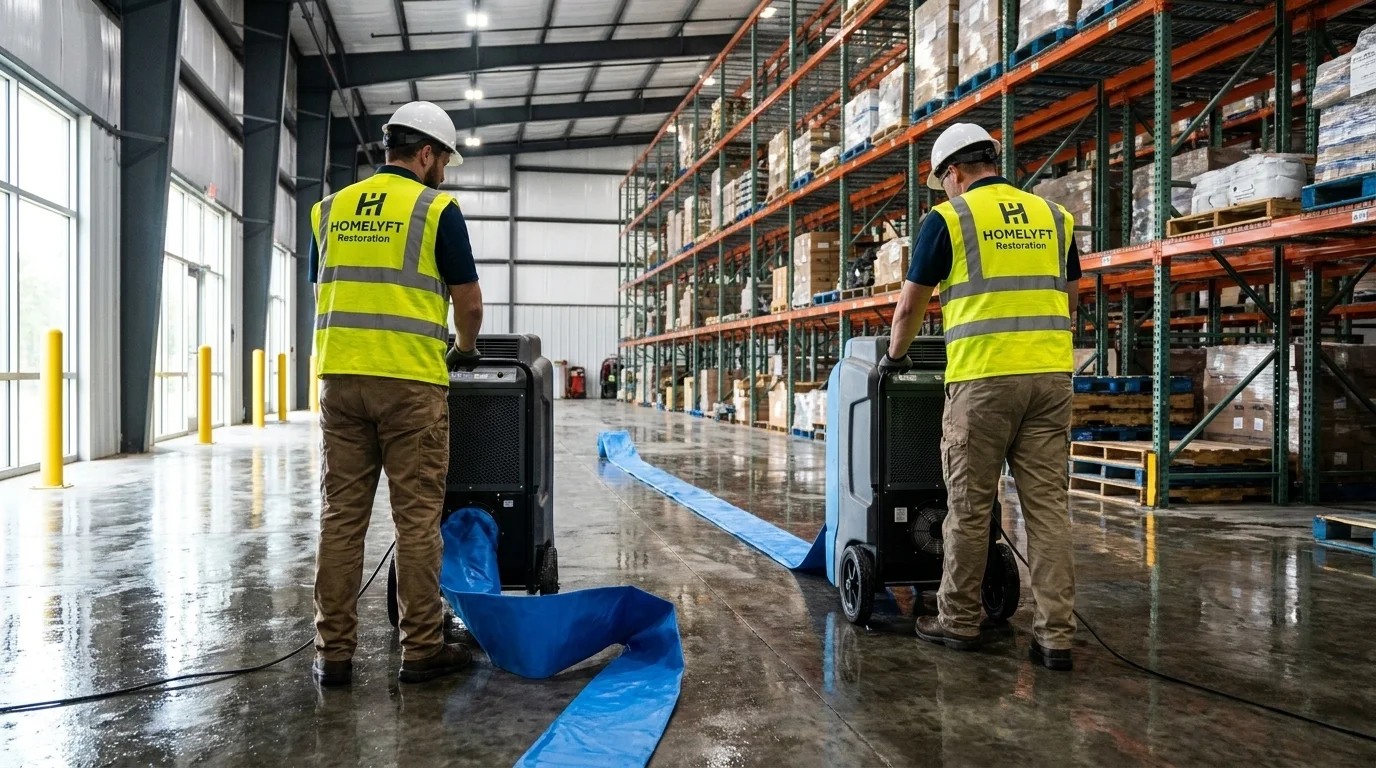
Industrial water or fire damage in a Gulfport facility? Call now for emergency service. We answer 24/7 and bring large-loss equipment sized for warehouses, manufacturing floors, and distribution centers, not residential-grade units stretched past their capacity.
A burst supply line in a 40,000-square-foot warehouse behaves nothing like a leak under a kitchen sink. Water travels fast across a flat concrete slab, pools under pallet racking where nobody sees it for hours, and wicks into insulation above a drop ceiling long before the smell reaches the office. A sprinkler head discharge in a manufacturing bay can sit undetected over a weekend, soaking subfloor and electrical conduit while production is down. These losses need equipment, documentation, and sequencing built for industrial scale, not a scaled-up version of a residential plan.
What industrial restoration actually involves
Industrial restoration covers water intrusion, fire and smoke damage, and the structural drying that follows inside warehouses, manufacturing plants, distribution centers, and processing facilities. The work differs from residential jobs in three ways: cubic footage, utility complexity, and the cost of downtime. A 30-foot ceiling holds a huge volume of air that has to be conditioned, not just the floor area. Facilities often run production lines, HVAC rooftop units, electrical panels, and fire suppression systems that have to be isolated or de-energized before drying or smoke removal can safely begin. And every day a section of floor is offline has a dollar figure attached to it, which shapes how the work gets sequenced.
Expect high-capacity LGR dehumidification, desiccant drying for large open volumes, negative air scrubbing where soot or airborne contaminants are present, and moisture monitoring logged daily rather than spot-checked. Timelines run longer than residential jobs, often one to three weeks depending on square footage, construction type, and how much of the facility has to stay operational during the work.
Our process
- Facility safety walk-through and utility isolation. Before anything is moved or dried, we identify electrical panels, machinery, catwalks, and any confined spaces, and coordinate lockout of power or water sources with facility staff or an electrician as needed.
- Large-loss extraction and structural drying. Industrial pumps and high-capacity dehumidification are sized to the actual cubic footage of the space, including ceiling height, not estimated off floor area alone.
- Moisture mapping across slab, decking, and wall cavities. We document psychrometric readings at fixed points through the drying process so there’s a clear, dated record for the facility and the adjuster.
- Phased reoccupation by zone. Cleared sections are released back to production or storage while drying or smoke remediation continues in the affected area, so the whole facility doesn’t sit idle.
- Soot characterization and air scrubbing for fire losses. On fire or smoke jobs, we identify whether residue is dry, oily, or protein-based before selecting cleaning method and equipment, then run negative air machines before ductwork, steel, or inventory is cleared.
What separates a good industrial restoration response from a bad one
The most common mistake is undersized equipment: a handful of residential dehumidifiers placed in a space with a 25-foot ceiling will never pull the humidity load down, and the slab or insulation reads dry at the surface while moisture sits trapped above a drop ceiling or inside wall panel insulation for weeks. A second mistake is treating sprinkler or fire-suppression water as clean when it’s often been sitting stagnant in pipe for years, which puts it in a different water category requiring different handling. Adjusters on industrial claims look closely at pre-loss inventory records, daily moisture logs, and whether electrical equipment was properly isolated before drying started, since improperly dried panels or motors can fail later and become a liability question. A documented, zone-by-zone drying and clearance record protects the claim and the facility.
What does industrial restoration cost?
Industrial losses vary enormously by square footage, construction type, and whether production has to stop entirely or can continue in cleared zones. The ranges below are typical industry figures, not a quote: every loss is different, and HomeLyft Restoration MS provides a written scope of work before any work begins. Most commercial property policies cover sudden water and fire losses, but coverage for business interruption or lost inventory often depends on specific policy language worth confirming with the carrier early.
| Scenario | Typical range |
|---|---|
| Localized sprinkler discharge, single bay | $3,500 - $9,000 |
| Warehouse water intrusion, 10,000 sq ft | $15,000 - $45,000 |
| Manufacturing floor smoke/soot, partial area | $25,000 - $75,000 |
| Large-loss structural drying, multi-zone facility | $50,000 - $150,000+ |
| Fire damage with equipment and inventory loss | varies significantly by scope |
Seasonal & regional considerations
Gulf Coast humidity means industrial drying timelines in Gulfport often run longer than the same loss would take in a drier climate, since ambient moisture works against the dehumidification equipment. Hurricane season brings a second risk: wind-driven rain through loading dock doors and roll-up seals, and roof system failures on large flat or low-slope commercial roofs. Facilities with FORTIFIED-standard roofing tend to hold up better in those events, which is also why we carry that certification for the roofing side of storm-related claims.
Service area
We respond to industrial and commercial facilities across Gulfport and the surrounding Mississippi Gulf Coast, including Biloxi, Long Beach, D’Iberville, and the industrial corridors throughout Harrison County.
If water, fire, or smoke has shut down part of your facility, call HomeLyft Restoration MS at (228) 284-5200 to schedule an industrial damage assessment and get a written scope of work started.
Frequently Asked Questions
Does homeowners or commercial property insurance cover industrial water and fire damage?
How is drying an industrial warehouse different from drying a house?
Can part of our facility stay in production while restoration work is underway?
What needs to happen to machinery and electrical panels before extraction starts?
Is soot from an industrial fire different from soot in a house fire?
Looking for the best industrial-restoration company in Gulfport?
HomeLyft Restoration MS provides licensed and insured industrial-restoration in Gulfport, MS and the surrounding area, and has served local property owners since 2022. Customers rate us 5.0 out of 5 stars across 61 Google reviews. We answer calls 24/7 — call +12282845200 for immediate help.
Need industrial-restoration now?
We respond 24/7 across Gulfport and surrounding MS cities.
Related Coverage
- Our Restoration Services
- Contact HomeLyft Restoration MS
- Restoration Services in Agricola
- Restoration Services in Bay St. Louis
- Restoration Services in Benndale
- Restoration Services in Big Point
- Restoration Services in Biloxi
- Restoration Services in D'Iberville
- Restoration Services in DeLisle
- Restoration Services in Diamondhead
- Restoration Services in Eastabuchie
- Restoration Services in Ellisville
- Restoration Services in Escatawpa
- Restoration Services in Gautier