
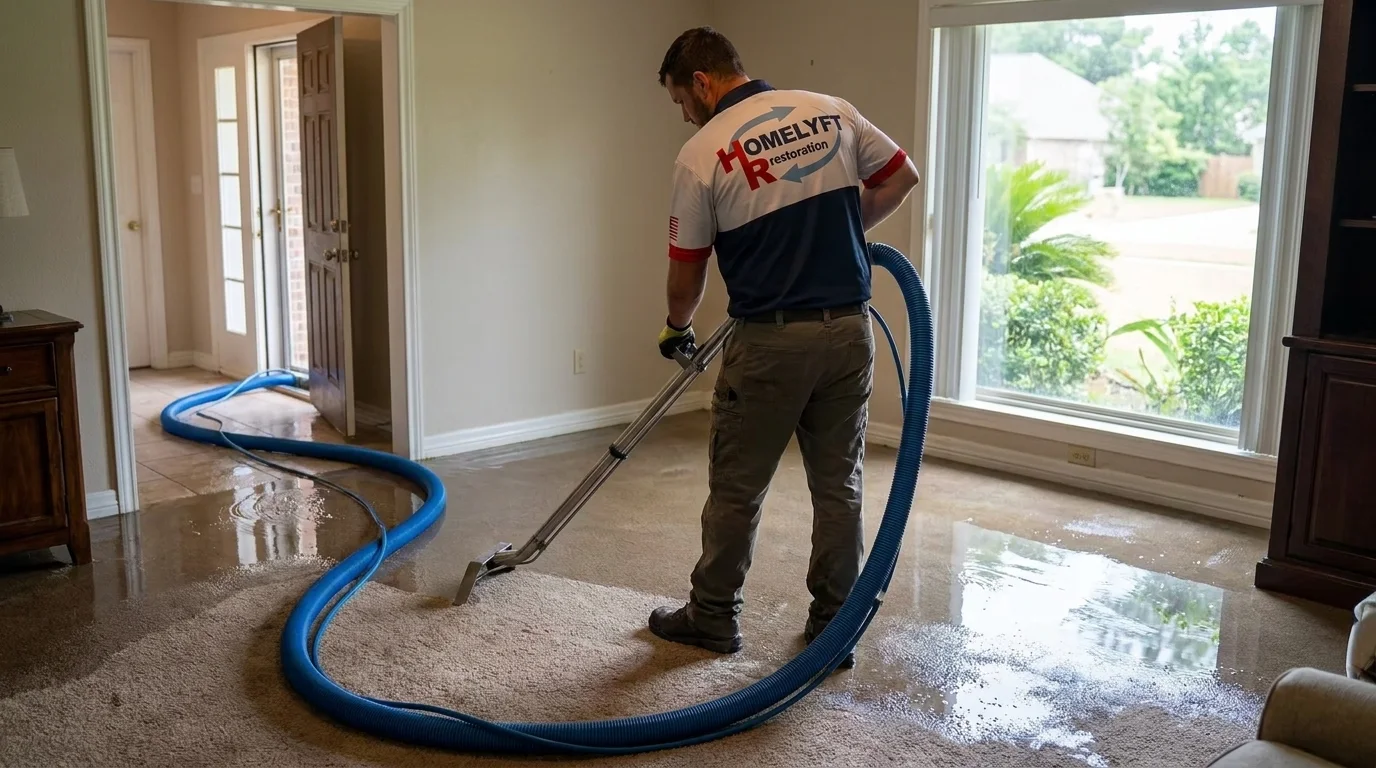
24/7 Emergency Flood Damage Restoration in Gulfport
24/7 emergency flood damage restoration in Gulfport and surrounding areas. IICRC-certified, insurance billing accepted. Call +12282845200.
Flood damage emergency in Gulfport? We answer 24/7. Call (228) 284-5200 now.
Flood water behaves differently than a burst pipe or a failed appliance line. It often carries silt, storm surge debris, or sewage backup from overwhelmed municipal lines, and it tends to rise from below, saturating slab foundations, crawlspace framing, and the bottom few feet of drywall before a homeowner ever sees standing water indoors. By the time carpet feels damp underfoot, insulation and subfloor may already be holding days of moisture. Flood damage restoration addresses that contamination and saturation together, not just the visible wet spots.
What flood damage restoration actually involves
Flood restoration starts with identifying what the water picked up on its way into the structure. Storm surge and overland flooding are almost always treated as Category 3 (grossly contaminated) water, which changes what can be dried in place versus what has to come out. Crews extract standing water with truck-mounted or portable pumps, remove flood-contaminated porous materials like carpet pad, baseboards, and often the lower section of drywall, and set positioning for air movers and dehumidifiers based on psychrometric readings, not guesswork. On a Gulfport slab home this frequently means drying trapped moisture inside wall cavities and under cabinetry where surge water pushed in through weep holes and expansion joints. Timelines run longer than a typical clean-water loss because contaminated materials require removal rather than in-place drying, and because Gulf Coast humidity slows evaporation even with equipment running.
Our process
- Water category and contamination assessment. We test and document whether the flood water is clean, gray, or black (storm surge and sewage backup are treated as black water) since this determines what materials can be saved.
- Extraction and contaminated material removal. Standing water comes out first, followed by carpet, pad, and any drywall or insulation that absorbed flood water and can’t be safely dried in place.
- Antimicrobial and sanitizing treatment. Exposed framing, subfloor, and remaining structural materials are treated to address bacteria and contaminants left behind once the standing water is gone.
- Structural drying with monitoring. Air movers, dehumidifiers, and daily moisture readings track progress against the IICRC S500 drying standard until framing and subfloor return to a dry standard, not just a dry feel.
- Documentation for your claim. Photos, moisture logs, and material removal records are compiled to support your insurance claim and any required local permitting for reconstruction.
What separates a good flood response from a bad one
The most common mistake is treating a flood loss like a simple water leak: drying surfaces with fans and calling it done while contaminated material stays sealed inside walls or under flooring. Flood water wicks upward into drywall and insulation well above the visible waterline, so moisture meters and sometimes borescope inspection are needed to find the real extent of saturation, not just where the water was standing. Adjusters reviewing flood claims look specifically for documented moisture readings over multiple days, photos of material removal before and after, and a clear explanation of why certain materials were removed rather than dried. Skipping antimicrobial treatment on exposed framing after a black-water event is another shortcut that shows up later as odor or microbial growth, and it’s a detail carriers increasingly ask about before approving reconstruction.
What does flood damage restoration cost?
Costs vary with how much water intruded, how contaminated it was, and how many materials have to be removed versus dried in place. Every loss gets a written scope before work begins because two homes with the same inch of floodwater can require very different scopes of work depending on flooring type and wall construction. Most homeowners insurance policies exclude flood water from a standard policy and require separate flood insurance (NFIP or private), so confirming your coverage early matters more on a flood loss than almost any other type of claim.
| Scenario | Typical range |
|---|---|
| Single room, shallow clean water, carpet only | $1,200 - $3,500 |
| Whole first floor, gray water, carpet and baseboard removal | $4,000 - $9,000 |
| Storm surge or sewage backup (Category 3), partial drywall removal | $7,000 - $18,000 |
| Crawlspace flooding with insulation and subfloor damage | $3,500 - $8,500 |
| Multi-room flood with structural drying over several days | $9,000 - $20,000+ |
Seasonal & regional considerations
Gulfport sits low along the Mississippi Sound, and hurricane season runs roughly June through November, when storm surge and heavy rain bands push water into homes faster than storm drains can carry it away. Older neighborhoods with slab foundations and a shallow water table are especially prone to water pushing up through floor penetrations rather than just entering through doors. High ambient humidity for most of the year also means structural drying after a flood takes longer here than in drier climates, which is one more reason moisture monitoring continues until materials actually test dry, not just until the air feels less damp.
Service area
HomeLyft Restoration MS responds to flood damage throughout Gulfport and the surrounding Mississippi Gulf Coast, including Biloxi, Long Beach, Pass Christian, Ocean Springs, and D’Iberville.
If flood water has reached your home, schedule your flood damage assessment now so extraction and drying can start before contamination spreads further into framing and flooring.
Services We Handle
- Flood Restoration
Frequently Asked Questions
Does homeowners insurance cover flood damage restoration?
How is flood water different from a regular water damage loss?
Can my carpet and drywall be saved after a flood?
How long does flood damage restoration take?
What should I do while waiting for a flood restoration crew?
Looking for the best flood-damage-restoration company in Gulfport?
HomeLyft Restoration MS provides licensed and insured flood-damage-restoration in Gulfport, MS and the surrounding area, and has served local property owners since 2022. Customers rate us 5.0 out of 5 stars across 61 Google reviews. We answer calls 24/7 — call +12282845200 for immediate help.
Need flood-damage-restoration now?
We respond 24/7 across Gulfport and surrounding MS cities.
Related Coverage
- Our Restoration Services
- Contact HomeLyft Restoration MS
- Restoration Services in Agricola
- Restoration Services in Bay St. Louis
- Restoration Services in Benndale
- Restoration Services in Big Point
- Restoration Services in Biloxi
- Restoration Services in D'Iberville
- Restoration Services in DeLisle
- Restoration Services in Diamondhead
- Restoration Services in Eastabuchie
- Restoration Services in Ellisville
- Restoration Services in Escatawpa
- Restoration Services in Gautier