
Upholstery Cleaning in D'Iberville
24/7 upholstery cleaning in D'Iberville, MS. IICRC-certified, insurance billing accepted. Call +12282845200.
Our IICRC-certified technicians are dispatched from our Gulfport, MS headquarters and are typically on-site in D'Iberville within 60 minutes of your call.
Gulf Coast humidity does something to upholstered furniture that most cleaning companies never explain: it keeps fabric fibers damp longer after a spill or pet accident, which gives odor-causing bacteria and mildew spores extra time to set in before they’re ever visible. In D’Iberville, where the air off Biloxi Bay stays thick with moisture most of the year, that head start matters. Upholstery cleaning here isn’t just about lifting stains, it’s about getting fabric and padding dry again before the climate works against you.
Why D’Iberville Furniture Faces a Different Set of Problems
Harrison County sits low and close to water, and D’Iberville’s mix of older ranch-style homes and newer construction built after the 2005 rebuild years both share the same vulnerability: high ambient humidity that keeps interior relative humidity elevated even with air conditioning running. Fabric sofas and sectionals in these homes absorb moisture from the air itself, not just from spills, which is why upholstery can develop a musty smell even in a household with no obvious accidents. Salt air carried inland from the Sound also settles on fabric fibers over time, which is part of why leather furniture along the coast tends to dry out and crack faster than the same piece would inland. Add in pine and oak pollen during the spring bloom, which works its way deep into upholstery weave, and you’ve got a furniture-care problem that’s genuinely regional rather than generic.
Our Upholstery Cleaning Process
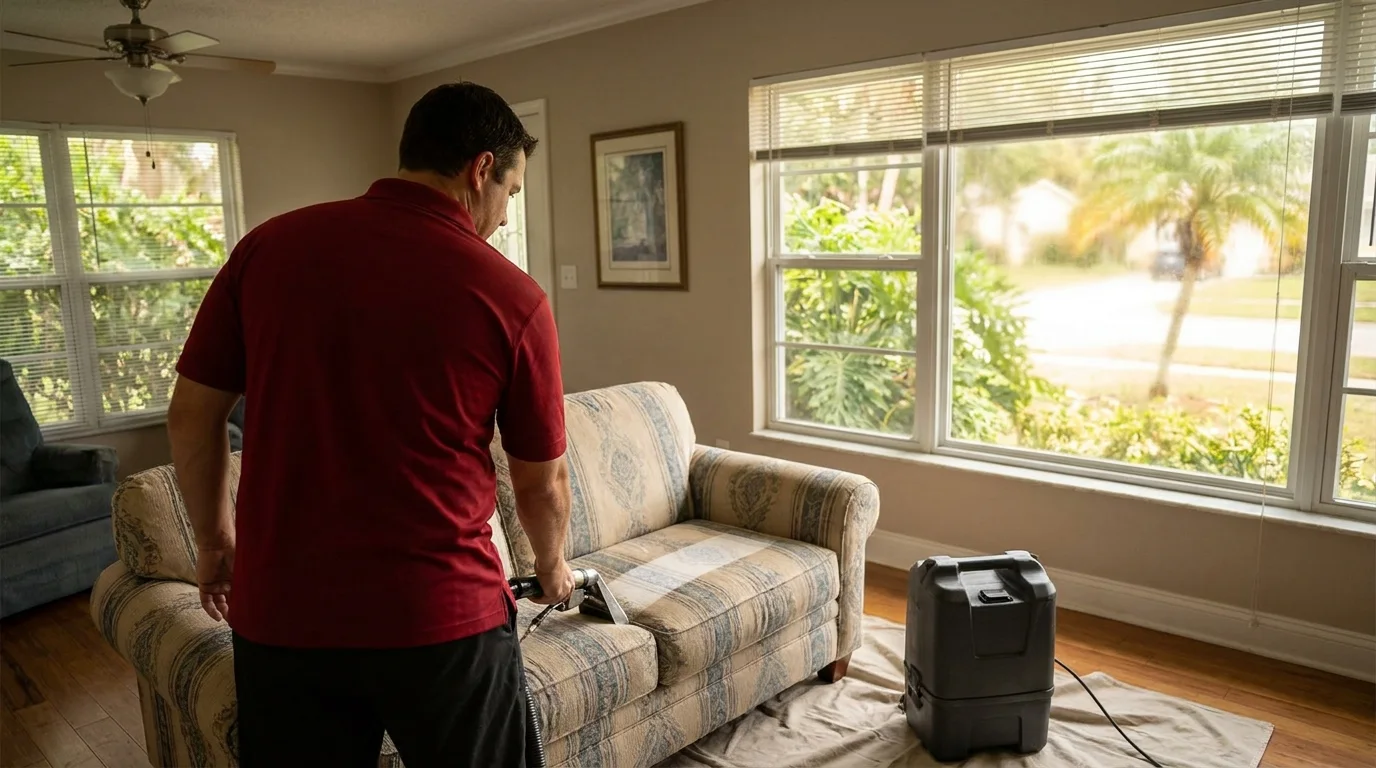
We start every job with a fabric identification step, because cleaning a synthetic blend sectional the same way as a natural-fiber sofa can set a stain permanently or damage the weave. Once we know what we’re working with, we pretreat protein stains and pet soiling with an enzyme solution, then move to hot water extraction for most fabric pieces, adjusting water temperature and dwell time based on how saturated the cushions already are from ambient humidity. Padding underneath the visible fabric matters just as much as the surface. In coastal homes we frequently find foam and batting holding more residual moisture than the owner expects, so we run moisture readings before and after cleaning rather than eyeballing it. Drying is the step most companies rush, and it’s the one we slow down on here: with air movers positioned to cut through the region’s humidity rather than fight it, most fabric pieces are dry to the touch within a few hours, though full cushion recovery can take longer depending on fill density.
Leather vs. Fabric: What Changes in This Climate
Leather upholstery near the coast needs a different approach than the same piece would in a drier inland market. Salt air and AC cycling pull natural oils out of leather faster, which is why cracking and stiffness show up sooner on Gulf Coast furniture than manufacturers’ care guides typically account for. We clean leather with a pH-balanced solution designed not to strip conditioning oils, then follow with a conditioning treatment that replaces what the coastal air has already taken out. Fabric upholstery gets the opposite concern: too much residual moisture. We calibrate extraction equipment to pull more water out on the back end for households in flood-prone low-lying pockets of the city, where indoor humidity tends to run higher even in well-maintained homes.
Local note
Homes closer to the Tchoutacabouffa River corridor and the bay-facing side of D’Iberville tend to run several points higher in ambient indoor humidity than homes farther from the water, even with comparable insulation and AC systems. On those jobs we lean toward low-moisture cleaning methods rather than a full hot water extraction, because fabric that’s already carrying baseline moisture from the air doesn’t need much more added before it stops drying properly. It’s a small adjustment, but it’s the difference between upholstery that smells clean the next day and upholstery that starts smelling musty again within a week.
If your sofa, sectional, or leather furniture is holding onto odor, staining, or that flat, slightly damp smell that coastal humidity leaves behind, HomeLyft Restoration MS can get a technician out to your D’Iberville home to assess the fabric, the padding underneath, and the right cleaning method for your specific piece. Call +1 (228) 284-5200 to get on the schedule.
Serving D'Iberville from our Gulfport headquarters — ★ 5.0 · 61 Google reviews
“We hired this company to mitigate the damage to our home after it sustained water damage from rising water during a torrential rain. They arrived at our home the very next day to start the process of remediating the damage. We truly cannot say enough good things about our experience with them. They…” — Emile, August 2026Read our reviews on Google →
Upholstery Cleaning in D'Iberville: Service Coverage
Frequently Asked Questions
How fast can you arrive for upholstery cleaning in D'Iberville?
Does D'Iberville's humidity really affect how often upholstery needs cleaning?
Can you treat leather furniture that's already showing cracking from salt air?
What's different about cleaning a sectional in a D'Iberville home versus an inland property?
How long does fabric upholstery take to dry after cleaning in this climate?
Do you work with homeowners insurance if upholstery was damaged in a water or storm event?
Upholstery Cleaning response in D'Iberville
Most D'Iberville calls see a technician on-site within 60 minutes from our Gulfport headquarters.